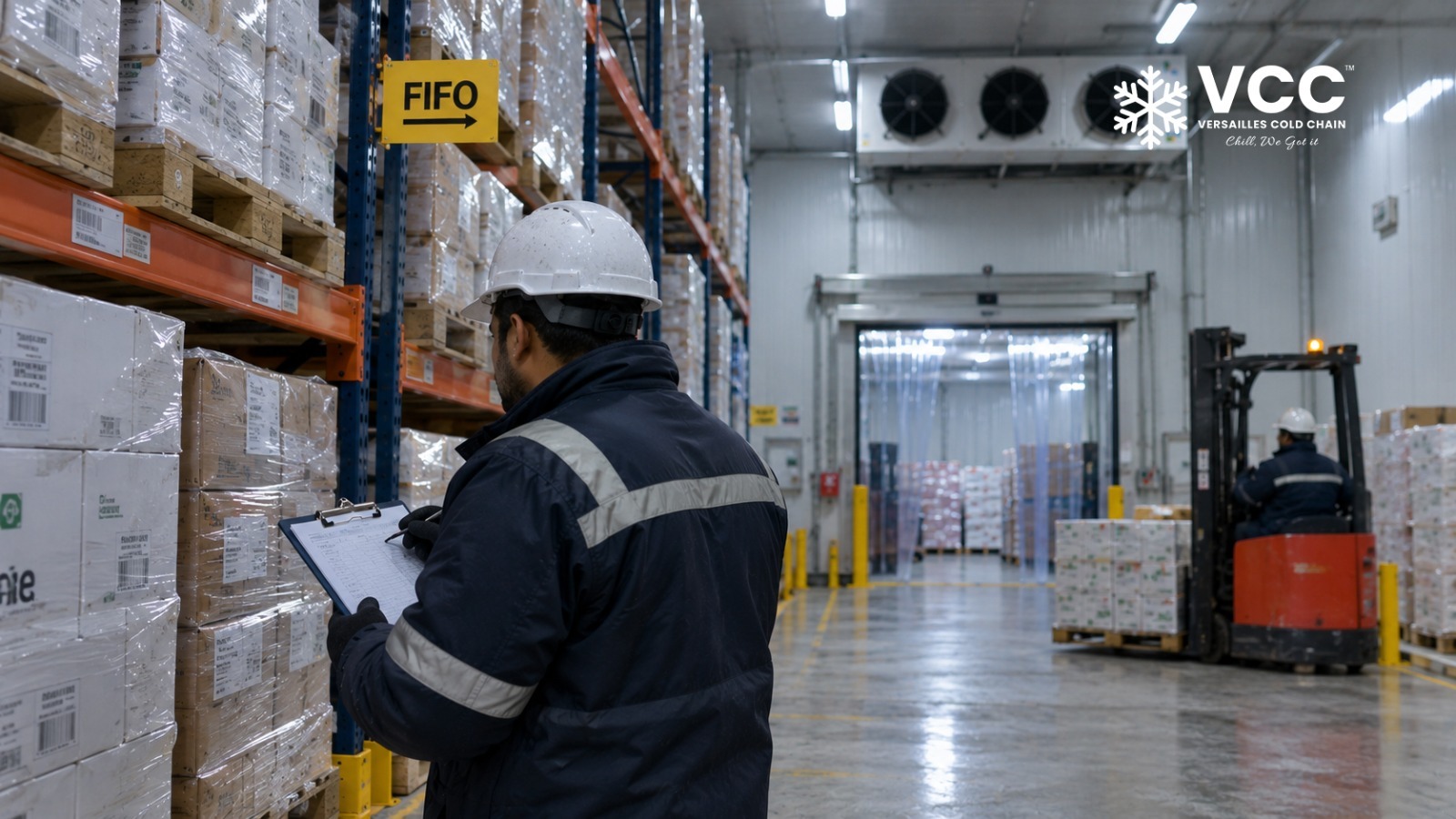
Old stock rarely expires because someone forgot it. It expires because the rack, the label, or the picking habit made the newer pallet easier to reach.
Quarter-end stock count. In the back row of a 2-8°C chamber, behind three fresh pallets of curd, your team finds 40 cartons that went past their use-by date nine days ago. Nobody hid them. They were put away early in the month, and every delivery since then landed in front of them. The pickers took what was closest to the aisle, as pickers do. Now there’s a write-off, a stock adjustment to explain, and a question from finance about how this keeps happening.
This is what weak FIFO inventory management looks like on the floor. It isn’t a software failure or a lazy team. It’s a storage room set up so that the easiest pick is also the wrong one. For goods that spoil, that small daily habit decides how much stock you throw away each year.
First In, First Out Sounds Simple. The Floor Says Otherwise.
The rule is easy to say: stock that came in first goes out first. Most warehouse managers will tell you they already follow it. Then you walk the racks.
Cold rooms make it harder than a dry godown. Space is expensive, so racks run deep and tall. Staff wear gloves and heavy jackets, which slows scanning and makes small print harder to read. Doors can’t stay open while someone hunts for the right batch, because every minute lets warm air in. Under that pressure, people grab the nearest pallet and move on.
The cost is real for short-life goods. Milk and curd may have a week or two. Fresh produce has days. Vaccines and biologics carry longer dates, but a batch that misses its window can still lose value, because many buyers won’t accept stock below a set share of remaining shelf life. That’s why FIFO inventory management in a cold storage warehouse is a design question, not just a rule on a poster.
“If the newest pallet is the easiest one to reach, your rack is quietly running last in, first out.”
— Versailles Cold Chain Editorial
Rack Layout That Makes FIFO Inventory Management Easy
Good rotation starts with layout. Four setups do most of the work.
Flow-Through Racking
Gravity-fed carton flow or pallet flow racks are loaded from one side and picked from the other. Older stock rolls forward on its own, so the picker simply can’t reach the newer batch first.
Drive-Through Instead of Drive-In
Drive-in racks have one face, so the last pallet in sits nearest the aisle. Drive-through racks open at both ends, so you load at the back and pick from the front.
Labels at Eye Level
Large-print labels showing batch number, inward date and expiry should sit where a gloved worker can read them without moving cartons.
One Batch per Location
Mixing batches in one slot is how old stock gets buried. Keep each pallet position to a single batch, even if it costs a little space.
FIFO or FEFO? Know Which One Your Product Needs
Here’s where many teams trip. Strict FIFO inventory management ships by arrival date, and for pharma that isn’t always right.
Two batches can arrive in the same week with very different expiry dates. One might have 18 months left and the other only six. Ship by arrival and you may send out the long-dated batch while the short-dated one ages on the rack. That’s why GDP practice and most pharma clients call for FEFO, which means first expiry, first out. Insulin, vaccines and biologics usually follow it.
Dairy, frozen meat, ice cream and fresh produce mostly work well on FIFO, because batches that arrive together tend to carry similar dates. FSSAI labelling rules require date marking on packaged food, which makes either method easier to audit. Many warehouses run FIFO as the default and switch to FEFO by product or client. The point is to pick a rule per SKU, write it down, and let the system enforce it.
Let Scans, Not Memory, Decide the Pick
In a small room, a sharp supervisor can hold rotation in their head. Past a few hundred pallets, nobody can.
A warehouse management system with barcode or RFID scanning turns FIFO inventory management into something the floor can’t skip. Every pallet is scanned at inward and tied to its batch, date and location. When an order comes in, the system tells the picker exactly which location to pull from. If they scan the wrong pallet, the handheld flags it before it leaves the chamber.
The same records give your auditor a clean trail. Pick any batch and you should see when it arrived, which chamber held it, its temperature history and which order it shipped on. In GDP-compliant storage, that trace matters as much as the temperature log. A good team pulls it up in minutes.
Where Rotation Usually Breaks
The racks are right, the system is live, and stock still slips. It usually happens in one of three places.
Rush orders come first. A big order lands at 6 p.m., the truck is waiting, and someone pulls whatever is quickest. One exception soon becomes a habit. Returns come next. Goods sent back by a distributor get put away in front of older stock instead of being checked and re-slotted by date. The third is dispatch. If the loading team works by convenience, the oldest batch can still sit on the dock while newer stock leaves on the first truck.
Proper cold chain logistics treats storage, picking and temperature controlled transport as one flow. When the same operator owns the chamber, the scanner and the reefer, FIFO inventory management holds all the way to the customer’s door. You’re not chasing three vendors to find out where a batch went.
Before you trust any rotation setup, check four things: racks that push old stock forward, labels a gloved hand can read, a scan at every pick, and a written FIFO or FEFO rule for each product. A provider who can show all four has earned some trust.
Ready When You Are
Versailles Cold Chain is built for cargo that can’t afford a single degree of error. It brings GDP-compliant cold storage warehousing, IoT-tracked real-time temperature monitoring and temperature controlled transport under one operator, for pharmaceuticals, vaccines, dairy, frozen foods and other perishables.
If you’re reviewing FIFO inventory management for a pharma, dairy or frozen food line, share your product list, temperature bands and monthly pallet volume with us. Request a quote or a facility walkthrough to see how stock is put away, picked and traced before you decide.