A sensor that reads perfectly in the wrong spot is worse than no sensor at all, because it tells everyone things are fine.
Saturday afternoon, a 2-8°C pharma chamber. The display by the door says 5°C, as it has all week. On Monday a QA officer checks a pallet on the top rack with a handheld probe and gets 10.4°C. The room’s only sensor sits a metre from the evaporator, in the coldest air in the building, while the top shelves have been running warm for days. Nobody missed an alarm, because there was simply nothing there to raise one.
That’s the quiet problem with a weak temperature monitoring system. The data isn’t missing. It comes from one corner of the room and gets treated as the truth for all of it. For vaccines, insulin or fresh dairy, a few degrees in the wrong place can decide whether a batch ships or gets written off.
What a Temperature Monitoring System Actually Does
At its simplest, a temperature monitoring system measures the air around your product, stores those readings and tells someone when a reading drifts out of range. Most cold stores in India have moved through three stages to get there.
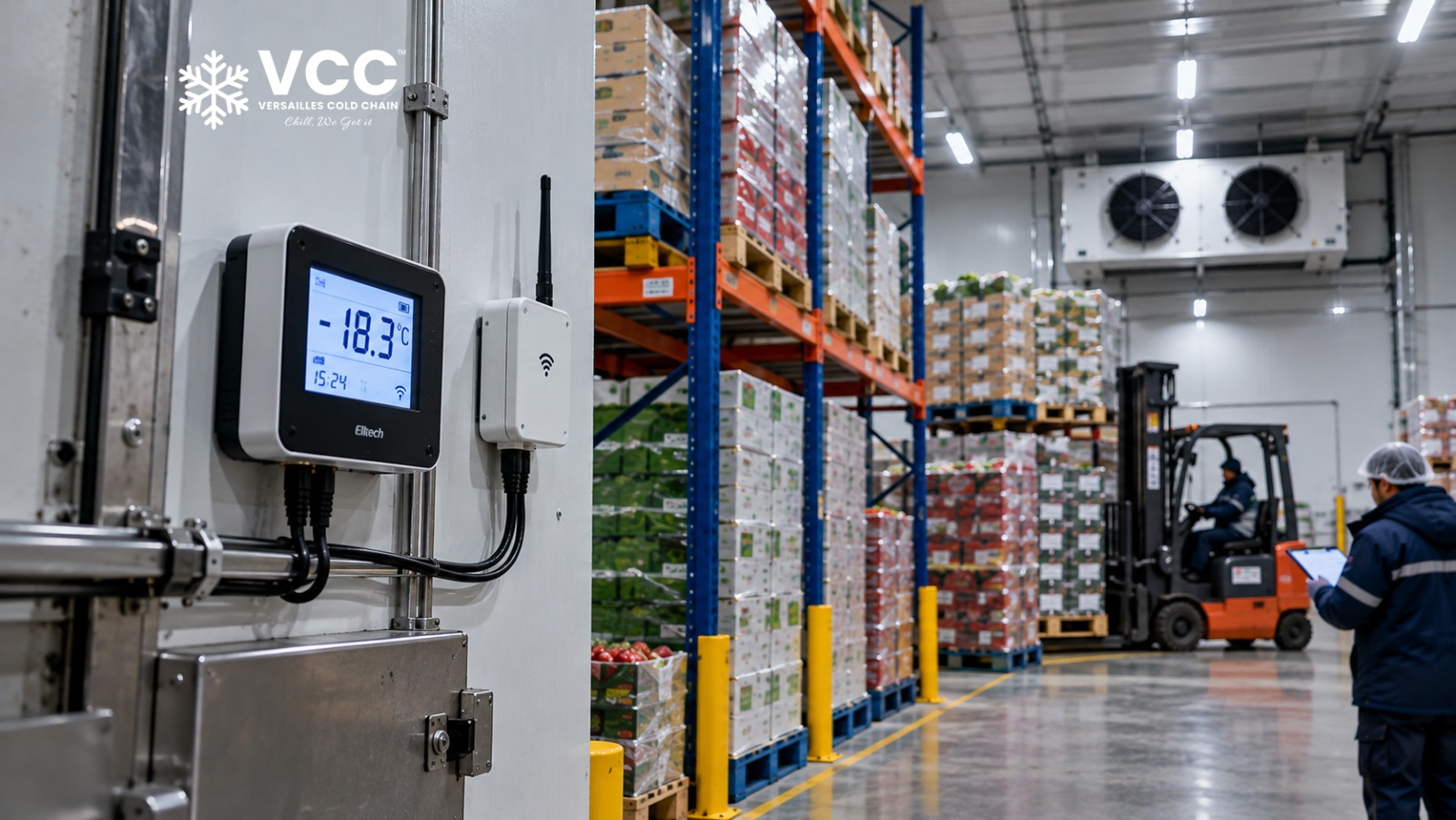
The oldest setup is a dial thermometer and a clipboard, with someone writing down the reading twice a day. It tells you very little about the twenty-two hours in between. Next came standalone data loggers, which record every few minutes but only show their story once someone plugs them into a computer. The newest step is a live, IoT-based temperature monitoring system, where sensors send readings to the cloud every minute or so and raise an alert the moment something drifts.
Only the last one lets you act while the product can still be saved. The first two mostly explain what went wrong after the fact.
“A thermometer tells you the temperature, while a monitoring system tells you when to worry.”
— Versailles Cold Chain Editorial
Four Parts Every Reliable Setup Needs
Whatever brand of hardware sits behind it, a dependable setup has four parts that all have to work.
Calibrated Sensors
Sensors should carry a valid calibration certificate and be rechecked at least once a year. A probe that has drifted by 1.5°C can make a room look safe right up to the day it isn’t.
Short Reading Intervals
In cold storage rooms, readings of every one to five minutes are normal. The shorter time between readings allows for the detection of rapid changes, like an open door during the loading process.
Alerts That Reach a Person
An alarm on a screen in an empty office helps nobody. Readings out of range should trigger an SMS, a call or an app alert to a named person on shift, with a second person called if the first doesn’t respond.
Backup Power and Connectivity
Sensors and gateways need battery backup, and the system should switch to a mobile network if the site Wi-Fi drops. Otherwise a power cut silences the very system that’s meant to warn you about it.
Sensor Placement Matters More Than Sensor Count
A room is never one temperature. Cold air pools near the evaporator and the floor, while warm air collects near the ceiling, around the doors and in the middle of tightly packed stacks. In summer, the wall facing the sun can run a degree or two warmer than the one opposite.
The fix starts with a temperature mapping study. Data loggers are placed across the room at different heights and corners, run with the room empty and again fully loaded, and repeated in summer and winter. The study shows exactly where the hot and cold spots are. The permanent sensors of your temperature monitoring system then go into those spots, not wherever the electrician found a socket.
Ask any cold storage warehouse how its sensors were placed. If the answer is “one per room near the unit”, you’ve found the same gap as in the story above.
Alarms People Don’t Learn to Ignore
Too many alarms are almost as bad as none. If a team gets twenty alerts a day for one-minute blips whenever a door opens, they start ignoring all of them, including the one that matters.
Good systems use two sensible tricks. The first is a short delay, so a reading has to stay out of range for several minutes before it triggers an alert. The second is two levels of warning. A soft alert at, say, 7.5°C gives the team time to check a door or a compressor, while a hard alarm at 8°C escalates up the chain. A well-tuned temperature monitoring system sends fewer alerts, and people take every one of them seriously.
From the Cold Room to the Truck
A well-monitored, cold environment will not be of much use when the goods warm up in the truck. Sensors in the refrigerated units should monitor the products inside the cargo area and report on the dashboard to show an overall view, rather than having to look for information from three separate systems which never converge. Inquire about the frequency of uploading the information in the refrigerated unit and what takes place when the truck is in a dead zone in the highway. The best units keep a record of the information while there is no signal and send it back when there is an internet connection.
Good cold chain logistics is a process that includes storage and temperature controlled transport as a continuous process. In case the same company controls storage and transportation, then any spike in temperature in either area will be immediately visible.
Before you trust any temperature monitoring system, check four things: calibrated sensors placed using a mapping study, readings at least every five minutes, alerts that reach a named person, and backup power with a mobile network fallback. Get all four right and most excursions are caught while they’re still small.
Ready When You Are
Versailles Cold Chain is built for cargo that can’t afford a single degree of error. It brings GDP-compliant storage, IoT-tracked real-time temperature monitoring and temperature controlled transport under one operator, for pharmaceuticals, vaccines, dairy, frozen foods and other perishables.
If you’re reviewing the temperature monitoring system behind your current cold store, or looking for a partner who runs one end to end, share your products and temperature bands with us. You can request a quote or a facility walkthrough to see the monitoring in action before you decide.